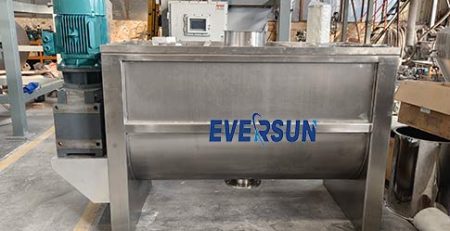
How to choose a suitable mixer
Choosing a suitable mixer is the key to ensuring product quality, production efficiency, safety, environmental protection, and economy. In practical applications, it is necessary to comprehensively consider factors such as raw material characteristics, process requirements, and production scale to select the most suitable mixing equipment.
Important factors need to be considered:
1. Raw material characteristics
(1) Physical properties of raw materials, such as particle size, density, fluidity, etc.
(2) Whether raw materials have problems such as adhesion, agglomeration, static electricity, etc.
(3) Whether raw materials require special mixing environments, such as vacuum, inert atmosphere, etc.
2. Process requirements
(1) Required mixing accuracy, uniformity, contact degree and other indicators.
(2) Special requirements of the process flow for mixing equipment.
(3) We also should consider downstream process requirements after raw material mixing.

3. Production scale
(1) Production volume of each batch and product turnover speed.
(2) Processing capacity and capacity of the mixer.
Possibility of future capacity expansion
4. Safety and environmental protection factors
(1) Whether special raw materials such as flammable, explosive, toxic and harmful are involved.
(2) Whether the mixing process will produce dust, gas and other pollutants.
(3) Whether the mixing equipment meets safety and environmental protection standards.
Combining the above factors, common types of mixers are:
Conical mixer: suitable for efficient mixing of powdered and granular raw materials.
Trough mixer: suitable for mixing larger batches of powdered and granular materials.
Double screw mixer: suitable for highly uniform mixing of powder and granular material.